
Paid Media Strategy That Pays Off: Integrating Ads, SEO & AI Search
By Amplified Audience Partners
Modern data metrics for media offer a greater wealth of information and more precision than ever in terms of being able to measure your actual results. That’s why it’s so important to have experts who can interpret and maximize that data handling your media strategy.
Using agencies and inexperienced outlets who don’t understand, can’t interpret and use incomplete AI assessments is a waste of your time and money. You get far better results and maximize your ROI with experienced and savvy strategists like those at Amplified Audience Partners.
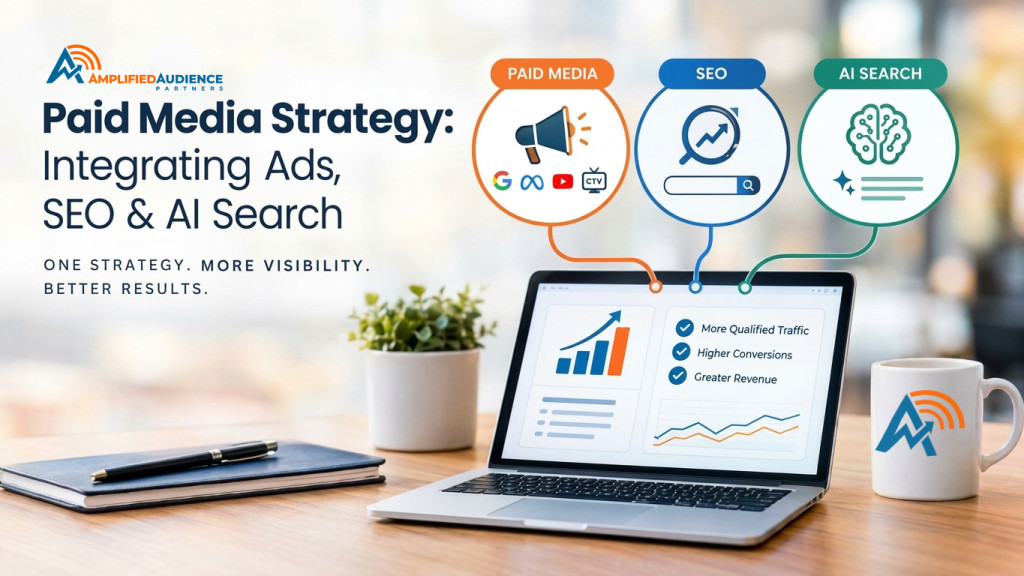
AAP takes a planned and strategic approach where paid media is planned as part of your whole marketing system, not run as a separate line item judged on clicks.
Most growing businesses have good intentions, but an approach that’s too broad and uninformed, when a more precise strategy would offer greater results. Companies are spending on Google Ads, a little on Meta, and maybe testing YouTube or streaming TV. Often each channel has its own vendor, its own dashboard, and its own definition of success. The SEO team never sees the search term data. The landing pages were built for a different campaign entirely. Nobody can say with confidence what last quarter’s ad spend actually produced. We can fix that. Here is how we connect paid media to organic and AI search strategy at Amplified Audience Partners, and what to ask of anyone managing your ad budget.
Why Standalone Ad Campaigns Underperform
Activity does not equal results. A campaign can look healthy in the ad platform and still lose money. Impressions, click-through rate, and cost per click describe activity, not outcomes. They don’t tell you whether the click became a call, a quote request, or a closed deal.
The bigger cost, though, is what gets left on the table. Your paid search account holds some of the most valuable market intelligence your business owns: the exact words buyers type when they’re ready to act, and which of those searches turn into real revenue. When paid media is run in isolation, that insight never reaches your website, your content team, or your organic and AI search strategy.
When every channel has a different vendor, no one owns the whole plan. Budget stays locked where it was set at launch instead of moving to what works. There’s a lot of activity, but not much payoff for you.
Start With Demand: Capture It or Build It
The right first channel depends on one question: Are people already searching for what you sell?
If they are, Google Search ads put you directly in front of them at the exact moment of decision. If they aren’t yet, YouTube, paid social, and programmatic media build awareness among the right audience so that demand exists to capture later.
| Channel | Best for | Funnel stage | How it’s measured |
|---|---|---|---|
| Google Search | Reaching people actively searching for your product or service | Bottom: decision and action | Leads, calls, sales, cost per lead |
| YouTube | Building awareness and consideration with video across mobile, desktop and CTV | Top to middle | Reach, view rate, engagement, site visits |
| Paid Social (Meta, LinkedIn) | Reaching defined audiences where they already spend time | Full funnel: awareness through lead gen | Reach, engagement, leads, cost per lead |
| Programmatic (CTV, Display, Audio, Digital Out-of-Home) | Reaching defined audiences at scale, down to household or ZIP code | Top to middle, plus retargeting | Reach, frequency, video completion, conversions |
Most strong growth plans pair one demand-capture channel with one or more demand-building channels. For businesses with clear search demand, we usually start with Google Search and scale into additional channels as revenue justifies an increased ad spend.
The Right Specialist for Every Channel
Google Ads, Meta, YouTube, and programmatic platforms each reward deep, hands-on channel expertise. Few in-house teams, and few generalist agencies, have genuine depth across every platform simultaneously.
Our model at Amplified Audience Partners splits the work using a precise strategy:
- Specialist Execution: Experienced paid media specialists from our curated network build, run, and optimize your campaigns day-to-day on each platform.
- Integrated Strategy: Amplified Audience Partners sets the overarching strategy, assigns channel budgets, and coordinates everything with your SEO, AIO, website, and analytics.
You get specialist-level execution without managing a roster of disconnected vendors. One partner, one unified plan, one point of contact.
Getting the Click Is Only Half the Job
Every ad makes an implicit promise. The landing page has to keep it. Plenty of campaigns send well-targeted traffic to a generic homepage, then wonder why so few clicks turn into leads.
Before scaling ad spend, we review and refine the destination pages. Every landing page should:
- Match the message and offer in the ad that drove the click.
- Answer the intent behind the search query or audience segment.
- Make the next step obvious, whether that’s a call, a form fill, or a purchase.
Because we also handle technical SEO and AI Search Optimization (AIO), landing page improvements made for paid traffic naturally strengthen your organic search presence too, with no orphaned campaign pages.
Measure What Happens After the Click
We agree on what success means for your business before anything launches, then report against it in plain English. That usually means qualified leads, customer acquisition cost (CAC), and revenue, not a vanity page of platform metrics.
Getting there requires robust tracking set up and verified before the first dollar is spent:
- GA4 event configuration and Google Tag Manager containers.
- Call tracking, since many high-value leads still pick up the phone.
- Offline conversion imports that connect ad clicks to deals closed inside your CRM.
- Meta Pixel & Conversions API (CAPI) for reliable paid social attribution.
Because paid media is measured inside the same analytics framework as your SEO, AIO, and website, you can compare channels directly and know exactly where the next marketing dollar belongs.
Paid Data Makes SEO and AI Search Smarter
Buying ads does not raise your organic rankings or earn citations in AI-generated search answers. Anyone who tells you otherwise is overselling.
What paid media does provide is fast, reliable evidence.
Within weeks, search term and conversion data reveal which exact topics, phrases, and value propositions convert into revenue. SEO and AIO take months to prove that on their own. We feed those paid insights directly into your organic content priorities, your AI search optimization work, and your website messaging.
The insight flows both ways. Organic and AI search performance shows where you already have strong visibility and where paid coverage should fill the gaps. Together, they make a far more potent allied strategy than when utilized separately.
Already Running Google Ads? Audit These 6 Areas First
If you have an active account, these are the areas where we most frequently find wasted spend and hidden growth:
- Search Terms: Review what people actually typed (not just your keyword list) and add negative keywords to block non-converting traffic.
- Campaign Structure: Reorganize campaigns around real products, services, or profit margins to make budgeting straightforward.
- Ad Copy Intent: Ensure ad copy speaks to the specific search intent of each tightly grouped keyword cluster.
- Landing Page Alignment: Verify that every ad group sends traffic to a dedicated page matching its exact offer.
- Conversion Tracking: Confirm that form submissions, phone calls, and CRM pipeline stages are accurately tracked.
- Budget Allocation: Shift spend away from high-click/low-conversion campaigns toward the channels delivering verified pipeline.
What to Expect, and Where to Start
Paid campaigns can start driving targeted traffic within days of launch, far faster than organic SEO. However, consistent, optimized performance takes time. Ad platforms need conversion data to learn, so plan for the first one to three months as a period of active testing and refinement before metrics stabilize.
After launch is where the real work happens. Costs, competitor bids, and user behavior continually shift. We stay in your accounts weekly: pruning search terms, adjusting bid strategies, testing creative and landing pages, and reallocating spend toward what drives qualified revenue.
Amplified Audience Partners offers you consistent, expert strategy and advice, not just an uninformed set-it-and-forget it buy. Whether you are launching paid campaigns for the first time or looking for an integrated strategy for an existing account, we can help you align paid media with your broader marketing strategy.
Ready to evaluate your current ad strategy?
Explore our Paid Media services or contact Amplified Audience Partners to start the conversation.
Decoding the AI Search Revolution: Your Complete AIO Glossary
By Amplified Audience Partners
In our previous post, we explored the fundamentals of AIO, which stands for Answer Intelligence Optimization, and why your business needs it to stay visible in an era driven by artificial intelligence. When potential customers stop browsing lists of blue links and start asking conversational search engines for direct recommendations, the rules of digital marketing change entirely.
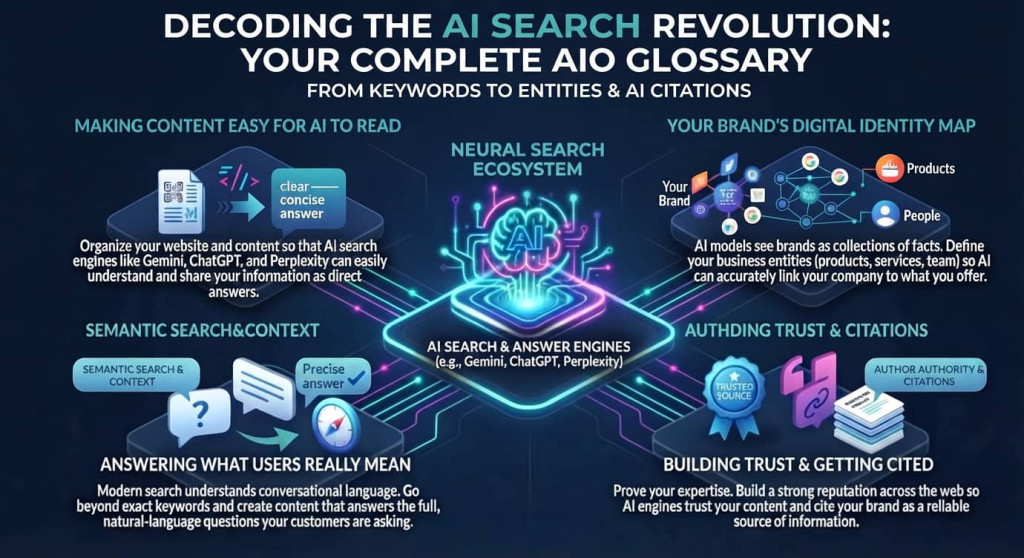
Mastering this new landscape requires getting familiar with the specific vocabulary of AI-driven search. At Amplified Audience Partners, we believe that demystifying these technical terms is the first step toward building a dominant online presence.
Below is a breakdown of the core AIO glossary terms, what they mean in plain English, and how our team helps clients put them into practice to secure top-tier visibility.
The Core Foundations of AIO
AI Search Optimization (AIO)
- What it is: The overarching discipline of optimizing a brand’s content, entities, website structure, and authority so AI-powered search and answer engines can discover, understand, reference, and recommend the brand.
- Why it matters: It is the master framework that replaces old-school keyword stuffing with machine-readable clarity.
- How we put it to work for clients: We architect your entire digital footprint so that AI platforms can easily read, trust, and feature your business.
AI Overviews
- What it is: Google’s AI-generated search results that synthesize information from multiple sources and provide direct answers within the search experience.
- Why it matters: These overviews sit at the very top of the search page, often pushing traditional results down out of view.
- How we put it to work for clients: We format and structure your content so your brand captures these prime conversational summary spots.
Answer Engine Optimization (AEO)
- What it is: Optimizing content specifically to be selected as a direct answer by answer engines and AI-powered search systems.
- Why it matters: It ensures your business is the specific solution delivered to users asking high-intent questions.
- How we put it to work for clients: We rewrite and format key service pages to directly answer the exact questions your buyers are asking.
AI Visibility
- What it is: The extent to which a brand, organization, product, or website appears in AI-generated answers across systems like ChatGPT, Google AI Overviews, Gemini, and Perplexity.
- Why it matters: This is the new metric of brand awareness; if you are invisible to AI, you are invisible to a massive share of modern buyers.
- How we put it to work for clients: We track and measure your brand presence across major AI platforms to benchmark your market reach.
AI Citations and Source Attribution
- What it is: The appearance of a website or other authoritative source as a cited or referenced source within an AI-generated answer
- Why it matters: Winning the citation means earning instant trust and direct referral traffic from users who want to learn more.
- How we put it to work for clients: We build out robust reference architecture that positions your website as the trusted expert source AI models love to cite.
Organizing Data for Machines
Entity Optimization
- What it is: Structuring and reinforcing information about people, organizations, products, services, and other entities so AI systems can accurately identify and associate them with relevant topics.
- Why it matters: AI models think in terms of distinct “entities” rather than random keywords.
- How we put it to work for clients: We clearly define your business components so machines understand exactly who you are and what you offer.
Knowledge Graph
- What it is: A structured network of entities and relationships that helps search engines and AI systems understand what things are and how they relate to one another.
- Why it matters: It provides the connective tissue that allows AI to link your brand directly to your industry expertise.
- How we put it to work for clients: We build clean backend entity maps that plug smoothly into major search engine knowledge graphs.
Semantic Search
- What it is: Search that interprets the meaning, intent, and relationships within a query rather than relying primarily on exact keyword matches.
- Why it matters: Users speak to AI in natural, conversational sentences, meaning your content must match human intent rather than robotic keyword strings.
- How we put it to work for clients: We craft content that addresses complete concepts and natural customer phrasing.
Contextual Relevance
- What it is: The degree to which content, entities, and supporting information align with the context and intent of an AI user’s query.
- Why it matters: AI models prioritize answers that match the precise context of what the user is trying to accomplish.
- How we put it to work for clients: We align your digital content with the real-world scenarios your customers face every day.
Authority and Trust Signals
Topical Authority
- What it is: The demonstrated depth, breadth, consistency, and credibility of a website’s coverage of a particular subject.
- Why it matters: AI models favor websites that prove deep, comprehensive expertise over sites that only touch on a topic superficially.
- How we put it to work for clients: We build interconnected content strategies that establish your brand as the definitive authority in your niche.
Authority Signals
- What it is: External and internal signals that help AI and search systems assess the credibility, expertise, and prominence of a source.
- Why it matters: Trust is currency in AI search; models want proof that your brand is respected by real people in your industry.
- How we put it to work for clients: We optimize your digital reputation, reviews, and cross-web mentions to maximize your trust score.
Directories and Structured Listings
- What it is: Business directories and other authoritative listings that reinforce an organization’s identity, location, services, and other entity information.
- Why it matters: Consistent directory data acts as a verification check for AI models confirming your business is legitimate and active.
- How we put it to work for clients: We audit and clean up your online citations and directory listings to eliminate conflicting information.
Sentiment Analysis
- What it is: The automated analysis of language to determine sentiment or opinion associated with a brand, product, topic, or entity.
- Why it matters: AI models evaluate how people talk about your brand online, factoring overall public sentiment into their recommendations.
- How we put it to work for clients: We monitor how your brand is perceived across digital channels and help reinforce positive customer sentiment.
Reputation Management
- What it is: Managing the accuracy, consistency, and overall representation of a brand across the digital sources AI systems may use when forming answers.
- Why it matters: Inaccurate web profiles can confuse AI models and lead to flawed brand summaries.
- How we put it to work for clients: We ensure your public digital profile is accurate, professional, and completely aligned across the web.
Structuring Content for AI Readers
Content Chunking
- What it is: Structuring content into concise, self-contained sections that can be more easily understood, retrieved, and potentially cited by AI systems.
- Why it matters: AI crawlers love bite-sized, logically organized information that they can easily parse and summarize.
- How we put it to work for clients: We format your web copy with clear subheadings and digestible sections designed for machine digestion.
Answer-First Content
- What it is: Content structured to provide a clear, direct answer before expanding into supporting detail, evidence, and context.
- Why it matters: Answer engines pull the most direct response first, rewarding content that cuts straight to the point.
- How we put it to work for clients: We restructure your messaging so the core takeaway appears immediately, followed by the supporting context.
Natural Language Processing (NLP)
- What it is: Technologies that enable machines to analyze and interpret human language, including the language used in search queries and website content.
- Why it matters: Writing for NLP means crafting natural, flowing copy that machines can interpret without stumbling over jargon or awkward phrasing.
- How we put it to work for clients: We write human-first content that remains effortlessly readable for AI algorithms.
Testing and Technical Mechanics
Prompt Engineering (As an AIO Testing Technique)
- What it is: The practice of designing and testing prompts to understand how AI systems respond to specific questions, topics, brands, and entities.
- Why it matters: Rather than just a creation tool, prompt engineering serves as a powerful research and testing technique for AIO.
- How we put it to work for clients: We use structured queries to test how conversational models perceive your brand against competitors.
AI Prompt Auditing
- What it is: Systematically testing AI systems with relevant prompts to measure brand visibility, mentions, citations, competitors, and answer accuracy.
- Why it matters: It gives you a clear scorecard of how often and how favorably your business appears in AI-generated answers.
- How we put it to work for clients: We run comprehensive prompt audits to identify gaps in your AI visibility and track improvement over time.
AI Search Query / Prompt Intent
- What it is: The underlying informational, commercial, navigational, or transactional intent expressed through an AI user’s question.
- Why it matters: Understanding what the user actually wants to achieve allows us to tailor your content to the exact stage of their buying journey.
- How we put it to work for clients: We map your web content directly to user intent so AI models can easily match your business with the right buyers.
Retrieval-Augmented Generation (RAG)
- What it is: An AI architecture in which a system retrieves relevant external information before generating an answer.
- Why it matters: Understanding retrieval behavior helps us ensure your content is the external source the system pulls into its working memory.
- How we put it to work for clients: We optimize your site architecture so retrieval systems can easily index and lean on your pages for real-time answers.
Bring Fractional Leadership to Your Brand
Navigating the shift toward generative search and advanced technical optimization does not require hiring a full-time enterprise team with prohibitive overhead.
At Amplified Audience Partners, we provide senior-level fractional marketing leadership and hands-on technical execution designed to scale your business. Whether you need a complete architectural overhaul, an advanced AIO strategy, or ongoing digital guidance, we turn your marketing into a reliable revenue engine.
Ready to future-proof your digital footprint and make your brand the definitive answer? Connect with the team at Amplified Audience Partners today to start the conversation.
Who is Fractional Marketing Really For?
(Hint: It’s Not the Executive)
By Amplified Audience Partners
Let’s clear up a common misconception right out of the gate.
When people talk about “fractional marketing,” the phrasing usually implies that fractional work is something for executives. But structurally, that doesn’t quite fit. Fractional isn’t for the CMO, VP, or Director—it’s for the company.
More specifically, fractional marketing is designed for businesses dealing with a leadership gap—whether that’s an open CMO vacancy, a missing VP of Marketing, or a sudden departure at the Director level. It’s a flexible model built for organizations scaling up or navigating transitions without the timeline, commitment, or overhead of a permanent, full-time executive search.
Here at Amplified Audience Partners, we talk to growing businesses every week caught in this exact spot. They have a gaping hole at the top of their marketing org chart, an internal team stretched thin by daily operations, and a market moving too fast to wait six months for a replacement.
Flexibility Means Tailoring Support to the Actual Need
Some agencies will tell you that you have to buy a massive retainer for everything. But at Amplified Audience Partners, we know that isn’t always what a business requires.
Sometimes you need a comprehensive, full-stack partner to fill a major leadership gap and drive execution top-to-bottom. Other times, you don’t need a massive overhaul. You might have a capable internal team, but you’re missing one critical puzzle piece. You need an isolated hire or a targeted service—whether that’s fixing your technical schema architecture, auditing your AI search visibility, executing a specific web development project, or running a focused campaign.
True flexibility means meeting a business wherever their friction point is. You shouldn’t have to buy a massive agency package just to get a complex technical problem solved, nor should you be forced to manage a chaotic roster of disconnected freelancers.
What This Looks Like in Practice
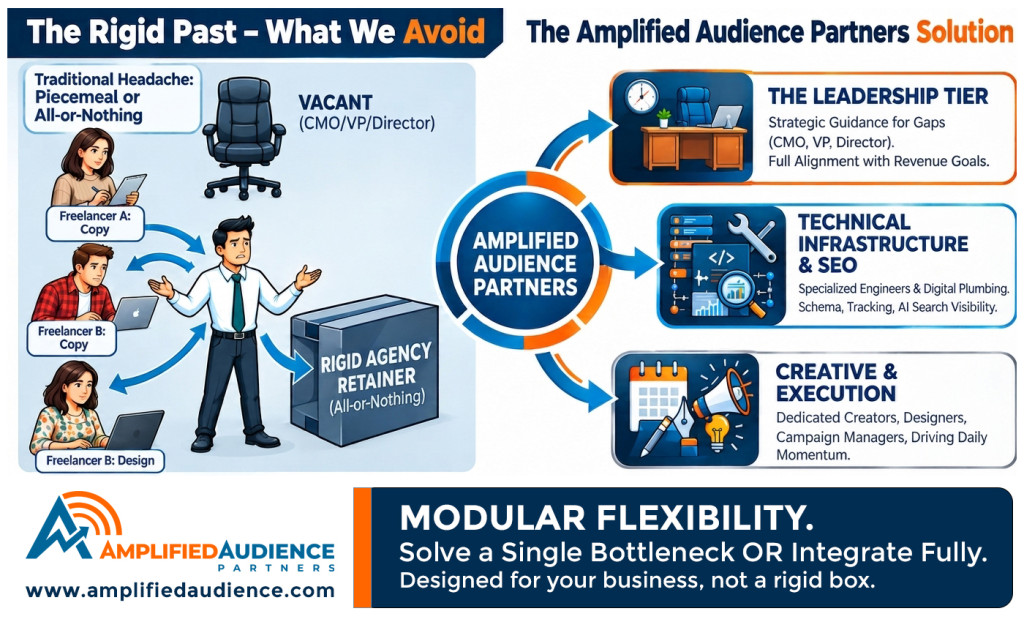
Depending on where your bottlenecks lie, our fractional talent can be deployed across the ecosystem—either as a unified engine or as targeted, individual expertise:
- The Leadership Tier: Stepping directly into a vacant CMO, VP, or Director seat to ensure every marketing dollar aligns tightly with business revenue goals and customer acquisition targets.
- Technical Infrastructure & SEO: Deploying specialized engineers for isolated projects or ongoing support to handle the digital plumbing—fixing search errors, structuring data for AI search engines, and setting up tracking architectures so buyers can actually find you.
- Creative & Execution: The content creators, designers, and campaign managers who bring campaigns to life week-in and week-out.
Moving Beyond the Traditional Agency Headache
When companies try to solve a marketing vacancy or a technical hurdle piece by piece, they often end up acting as the general contractor for a frustrating mix of misaligned freelancers and rigid agencies.
That’s why whether you need an integrated partner to run the whole engine or an isolated expert to solve a targeted challenge, you deserve a team that adapts to your business, rather than forcing you into a rigid box.
Ready to solve your next marketing challenge—big or small?
Connect with Amplified Audience Partners today.
The Fractional Advantage: Why Growing Businesses Are Leaving Traditional Agencies Behind

What is a fractional marketing partner? A fractional marketing partner is an outsourced leadership model where businesses gain access to a senior Chief Marketing Officer and strategic team on a flexible, part-time, or project basis, delivering executive-level expertise without the overhead of a full-time hire.
By Amplified Audience Partners
In today’s hyper-competitive digital landscape, growing businesses face a unique paradox. To scale effectively, dominate search visibility, and capture attention across AI-driven engines, you need high-level marketing leadership. But hiring a full-time, experienced Chief Marketing Officer or building an enterprise-grade internal team is often cost-prohibitive. On the flip side, traditional marketing agencies frequently assign your account to junior account managers who juggle dozens of clients, leading to cookie-cutter strategies and disconnected tactics.
There is a smarter way to scale. It’s called Fractional Marketing, and it is fundamentally changing how companies approach growth, ROI, and market dominance.
What Is Fractional Marketing?
Fractional marketing provides businesses with executive-level marketing strategy, technical execution, and leadership on a fractional or part-time basis. Instead of paying a six-figure salary plus benefits for a full-time CMO, you invest only in the exact hours and strategic horsepower your business requires.
More importantly, a true fractional partner doesn’t just hand you a strategy deck and walk away. They embed themselves into your operations, lead your existing team, align your sales and marketing funnels, and drive execution from the top down.
For mid-market companies, startups, established businesses looking to break through a revenue plateau, and enterprise level companies in temporary transition, the fractional model offers distinct advantages over traditional employment and agency retainers:
1. Executive-Level Expertise on Demand
You gain decades of senior leadership experience across branding, digital ecosystems, MarTech stacks, and modern search optimization. This eliminates the trial-and-error phase common with junior staff and ensures your marketing dollars are deployed with precision from day one.
2. Unmatched Cost Efficiency
Building an internal C-suite marketing team is expensive. Fractional marketing delivers senior leadership at a fraction of the cost, freeing up capital to invest directly into paid media, content development, and lead generation campaigns.
3. Agility and Scalability
Your business needs fluctuate, and your marketing support should too. Whether you need a massive push for a product launch, a complete technical overhaul of your digital infrastructure, or steady strategic oversight, a fractional partner scales up or down alongside your business goals.
4. Holistic Ecosystem Integration
Disconnected marketing tactics fail. A fractional CMO ensures that your web development, Technical SEO and AI Optimization, customer relationship management (CRM) workflows, and paid acquisition channels work together as a unified, high-performing revenue engine.
Why Choose Amplified Audience Partners?
At Amplified Audience Partners, we don’t believe in vanity metrics, flashy jargon, or generic agency retainers. We believe in building measurable momentum that transforms your audience into active, loyal brand advocates.
When you partner with our team, you aren’t getting handed off to an entry-level coordinator. You are working directly with seasoned marketing executives who specialize in cutting-edge growth strategies. Here is what sets us apart:
-
Advanced Technical & AI-Driven Visibility: Beyond traditional search engine optimization, we future-proof your digital presence for the modern web—optimizing your site for AI Search Optimization (AIO), Generative Engine Optimization (GEO), schema architecture, and LLM visibility.
-
Custom MarTech & Analytics Mastery: We configure and harness powerful data ecosystems—including GA4, HubSpot, and NetSuite—ensuring every marketing dollar is tracked, measured, and optimized for maximum ROI.
-
Senior-Led Execution: Our leadership team brings decades of hands-on agency and corporate marketing success across creative direction, digital infrastructure, and direct-response strategy.
-
Tailored Growth Frameworks: We utilize structured, rigorous prospecting and audit methodologies to diagnose your brand blind spots, align your messaging, deploy advanced schema architecture, build technical LLM.txt files, execute custom search engine optimization strategies, craft impactful public relations campaigns, oversee comprehensive web design and development, and accelerate your path to market leadership.
Ready to stop guessing and start amplifying your market impact? Explore our core Services or Contact Us today to schedule your custom growth audit.
Frequently Asked Questions
What is the difference between a traditional marketing agency and Amplified Audience Partners?
Traditional agencies often lock you into rigid retainers while delegating your work to junior staff focused on billable hours rather than business outcomes. Traditional agencies often lock you into rigid retainers while delegating your work to junior staff focused on billable hours rather than business outcomes. As highlighted on our About Us page, Amplified Audience Partners operates as an embedded fractional extension of your team, providing senior-level executive leadership, technical depth, and complete alignment with your revenue goals.
Is fractional marketing right for my company size?
Fractional marketing is an ideal solution for growing small-to-mid-sized businesses, B2B enterprises, and startups that have outgrown basic freelance help. It is equally valuable for enterprise-level companies navigating temporary transitions or in the middle of making full-time hiring decisions. Ultimately, it delivers high-impact leadership right when you need it most.
How do we get started with Amplified Audience Partners?
Getting started is simple. We begin with a comprehensive audit of your current digital footprint—evaluating your website architecture, SEO standing, and AI search readiness. Visit our FAQ page or reach out directly through our Contact portal to start the conversation.
Why Most Website Audits Miss the Point Entirely

A checklist isn’t a strategy. The audits that actually move the needle go deeper than broken links and page speed scores — they evaluate UX flows, compliance, and digital architecture.
By Amplified Audience Partners
Most website audits are a waste of time. Not because the findings are wrong — they’re usually accurate — but because they’re answering the wrong question. A list of broken links and slow-loading images tells you what’s broken. It doesn’t tell you why your website isn’t converting.
The Checklist Trap
Automated audit tools are useful for catching technical issues. But they’ve created a false sense of thoroughness. A site can score 95/100 on PageSpeed Insights and still be hemorrhaging leads because the value proposition is buried, the contact form is three clicks deep, or the mobile experience is confusing.
Real website audits start with business objectives. What is this website supposed to do? Generate leads? Drive e-commerce revenue? Build brand credibility? Every finding should be evaluated against that objective.
What a Real Website Audit Covers
- Conversion architecture: Are the calls to action clear, prominent, and compelling? Is the path from landing to conversion as short as possible?
- Content clarity: Does a first-time visitor understand what you do, who you serve, and why you’re the right choice — within 10 seconds?
- Trust signals: Are there testimonials, case studies, credentials, or other proof elements that reduce purchase anxiety?
- Technical health: Core Web Vitals, mobile responsiveness, crawlability, and structured data — these matter, but they’re table stakes, not differentiators.
- Compliance: Privacy policy, cookie consent, accessibility (WCAG 2.1 AA) — these are increasingly non-negotiable, especially for businesses serving EU customers.
The Output That Matters
A good audit doesn’t end with a list of problems. It ends with a prioritized action plan: here are the three changes that will have the biggest impact on your business goals, here’s why, and here’s how to implement them.
That is the exact philosophy behind our technical and strategic offerings at Amplified Audience Partners. Through our fractional marketing and digital transformation services, we help brands look past surface-level metrics to build high-performance digital architectures that actually drive revenue.
Ready to move beyond automated checklists and get a roadmap that actually works? Amplify Your Growth with our comprehensive audit and advisory services.
5 Ways to Boost Small Business Marketing

Breaking Through the Noise: Marketing That Moves the Needle
Standing out as a small business in today’s digital-first world is tougher than ever. With shrinking attention spans and rising competition, even great offerings can get buried—especially in tight-knit markets like Bettendorf or the broader Quad Cities region. Many local brands face the same hurdles: inconsistent online visibility, unclear messaging, and marketing efforts that fail to convert browsers into buyers. The result? Missed opportunities, stagnant growth, and frustration.
But effective small business marketing doesn’t demand a massive budget or a social media army. What it does require is strategy, consistency, and a deep understanding of your local audience’s behavior. When done right, marketing becomes a powerful engine for trust, engagement, and repeat business.
In this guide, you’ll learn five high-impact strategies designed specifically for small businesses aiming to boost visibility, strengthen local connections, and generate measurable results. From mastering local search to building customer-centric campaigns, each tip is rooted in practical, actionable steps that can be implemented without guesswork—giving you the tools to grow with confidence.
Master Your Local Online Presence
When potential customers in Bettendorf or nearby communities search for services like yours, will they find you? For small businesses, dominating local search results isn’t just helpful—it’s essential. A strong local online presence connects you with buyers actively seeking solutions in your area, driving both foot traffic and qualified leads. Start by claiming and optimizing your Google Business Profile. Ensure your business name, address, and phone number (NAP) are 100% consistent across all platforms—accuracy builds trust with both users and search engines.
Next, prioritize customer reviews. Positive, authentic feedback doesn’t just build credibility—it boosts local SEO rankings. Encourage satisfied clients to leave reviews through follow-up emails or in-person requests.
Infuse location-based keywords naturally into your website content, such as “marketing consultant near Bettendorf” or “small business marketing services in Iowa.” Create dedicated landing pages for each service area, incorporating local landmarks, events, or testimonials. This hyper-relevant content enhances user experience and signals geographic authority to search algorithms.
Don’t forget visual credibility: upload high-quality images of your team, storefront, or local projects. And maintain activity by posting monthly updates, offers, or community involvement highlights. These consistent efforts build long-term visibility and trust in your local market.
3 Proven Tactics to Dominate Local Search Results
Local SEO is one of the most powerful tools small businesses have to attract nearby customers actively searching for solutions. With the right strategy, you can appear in “near me” searches and location-based queries that drive high-intent traffic straight to your door. Follow these three actionable tactics to strengthen your geo-targeted visibility and outperform local competition.
1. Optimize Your Google Business Profile with Fresh, Accurate Data
Ensure your business information—name, address, phone number, and service areas—is 100% consistent across all platforms. Add high-resolution photos of your team, location, and services, and post regular updates like promotions or events to keep your profile active. Promptly respond to customer reviews, both positive and negative, to build trust and show engagement.
2. Build Location-Specific Content That Resonates
Create dedicated landing pages for each neighborhood, city, or region you serve. Use natural, conversational phrases like “marketing services in Bettendorf” or “small business support near Quad Cities” in your page titles, headers, and body text. Include local references such as landmarks, events, or community partnerships to boost regional relevance.
3. Strengthen Citations and Local Backlinks
List your business in reputable local directories, industry associations, and chamber of commerce sites. These citations reinforce your legitimacy to search engines. Additionally, earn backlinks from local blogs, news outlets, and partner websites to enhance domain authority and improve local pack rankings over time.
Create Content That Connects with Your Community
Engaging local audiences starts with content that speaks directly to their needs, values, and everyday experiences. Instead of generic messaging, focus on storytelling that highlights real-life applications of your services within the community. Share customer success stories—without naming names if needed—that reflect common challenges faced by residents in Bettendorf or the wider Quad Cities area. This builds familiarity and trust, making your business feel like a natural part of their world.
Use locally relevant topics to drive engagement: write about seasonal trends, community events, or regional economic shifts that impact small business owners. For example, a piece on “Marketing Tips for Spring Pop-Ups in the Quad Cities” positions your expertise in a hyper-local context. Incorporate location-specific keywords like “small business marketing in Iowa” or “growing your Bettendorf shop” naturally throughout your content to boost geo-targeted search visibility.
Prioritize formats that encourage interaction:
- Post short video tips featuring recognizable local backdrops
- Create social media polls asking followers about their top challenges
- Publish blog updates tied to nearby events or holidays
When your content reflects the community’s voice and concerns, it resonates deeper, shares more widely, and performs better across search and social platforms.
Measure, Adapt, Grow: Turning Marketing Data into Results
Understanding how your marketing efforts truly perform is the foundation of sustainable growth. For small businesses aiming to maximize every dollar, knowing which strategies drive traffic, convert leads, and build customer loyalty is essential. Instead of guessing what works, focus on tracking key performance indicators (KPIs) that reflect real business outcomes—like website conversion rates, cost per lead, and customer acquisition cost.
Start by setting clear, measurable goals for each campaign. Are you aiming to grow your email list, increase online bookings, or drive more foot traffic to your Bettendorf storefront? Once goals are defined, use built-in analytics tools to monitor progress. Track where your visitors come from—organic search, social media, or paid ads—and assess which channels deliver the highest engagement and conversions.
Regularly review your data—ideally monthly or quarterly—and look for trends. A sudden drop in referral traffic might signal technical SEO issues, while rising bounce rates could point to mismatched messaging. Use these insights to refine your content, reallocate budgets to top-performing channels, and optimize underperforming campaigns.
Don’t overlook customer feedback and review patterns—they’re qualitative metrics that complement your numbers. When combined, quantitative data and customer sentiment give you a complete picture, enabling agile, informed decisions that keep your small business marketing strategy ahead of the curve.
Your Small Business Marketing Questions—Answered
How do I get more visibility in local searches?
Start by claiming and optimizing your Google Business Profile with accurate NAP (Name, Address, Phone) details, relevant categories, and high-quality photos. Ensure your business appears in local directories and maintain consistency across all platforms. Use localized keywords like “marketing services in Bettendorf” or “small business support in Quad Cities” throughout your website content, headers, and meta descriptions to align with real user search behavior.
Why aren’t my social media efforts driving results?
Focus on quality over quantity. Post consistently, but tailor content to where your audience spends time. Use a mix of educational posts, behind-the-scenes updates, and customer testimonials. Engage through comments, DMs, and interactive stories—authentic interactions build trust faster than passive scrolling.
What type of content resonates best with local customers?
Create hyper-relevant content such as community event guides, local success stories, or neighborhood-specific tips. For example, “5 Marketing Tips for Bettendorf Retailers” signals local expertise and boosts geo-targeted SEO performance.
How often should I ask for customer reviews?
Request reviews shortly after a positive interaction—via email follow-ups or receipt messages. Keep it simple and friendly. Encourage feedback across platforms like Google and Facebook to strengthen credibility.
Is email marketing still effective for small businesses?
Yes, especially when segmented. Send targeted campaigns based on customer behavior or location, like exclusive offers for clients in the Quad Cities area. Personalization increases open rates and conversions.
Take Charge of Your Marketing Success
Now that you’ve explored five powerful strategies to enhance small business marketing, it’s time to turn insight into action. The foundation of lasting growth lies in consistency, clarity, and a customer-first mindset. From optimizing your local SEO presence to creating content that resonates with your community in Bettendorf and across the Quad Cities region, each step plays a vital role in building visibility and trust. Remember, success doesn’t come from one bold move—but from steady, intentional efforts aligned with real customer needs.
Start by auditing your current marketing approach: Is your business information consistent online? Are you actively engaging with local customers through reviews and content? Are your website pages optimized with location-specific keywords like “marketing services in Iowa” or “small business support near me”? Prioritize one area at a time, track your progress, and refine based on what resonates.
Don’t underestimate the compounding effect of small, strategic changes. Whether it’s claiming your Google Business Profile, publishing locally relevant content, or encouraging genuine customer feedback, each action strengthens your digital footprint.
You don’t need a big budget—just a clear plan and the willingness to take consistent steps forward. Your audience is searching. Make sure they can find you, recognize your value, and choose your business with confidence. The tools are within reach—now is the time to use them.
Ready to turn these marketing strategies into a plan that actually grows your business? Amplify Your Growth with practical marketing strategy, SEO, and AI optimization built around your business and your goals.
Structured Data in 2026: What Still Works and What’s Noise
Schema markup has evolved. Not all structured data types carry equal weight — this breakdown shows where to focus your implementation effort for maximum impact in both traditional and AI search.
By Amplified Audience Partners

Schema markup has been a staple of technical SEO for over a decade. But as search engines have grown more sophisticated — and as AI-powered search has emerged — the landscape of what actually matters has shifted considerably.
What Structured Data Still Works
FAQ Schema: Still one of the highest-ROI schema implementations. FAQ markup can trigger rich results in traditional search and provides clear, structured Q&A content that LLMs can parse and cite directly.
Article / BlogPosting Schema: Essential for any content-driven site. Properly implemented Article schema signals publication date, author, and content type — all signals that matter for both Google and AI systems evaluating content freshness and authority.
Organization Schema: The foundation of entity authority. A well-structured Organization schema with consistent NAP data, social profiles, and sameAs references is one of the most important things you can do for AI search visibility.
LocalBusiness Schema: For businesses with a physical presence or defined service area, LocalBusiness schema remains highly effective for local search and AI-generated local recommendations.
What’s Mostly Noise
Breadcrumb Schema: Useful for UX, but the SEO impact is minimal. Implement it if it’s easy, but don’t prioritize it.
Product Schema without reviews: Product schema is powerful when paired with Review/AggregateRating schema. Without ratings data, the impact is limited.
Event Schema for past events: Only implement Event schema for upcoming events. Past events add noise without benefit.
The AI Search Angle
For AI search optimization specifically, the most valuable schema types are those that help LLMs understand who you are (Organization), what you know (Article, FAQ), and where you operate (LocalBusiness). Think of schema as a structured briefing document for AI systems — the clearer and more complete it is, the better your chances of being cited.
Not sure if your structured data is helping your visibility—or just adding noise? Amplify Your Growth with a strategic schema audit designed to identify what matters, what doesn’t, and where to focus next.
Why SEO Is Still Essential in the Age of AI

Published by Amplified Audience Partners LLC
Every few years, a sweeping technological shift occurs in digital marketing, accompanied inevitably by a chorus of proclamations declaring traditional search engine optimization (SEO) dead. With the explosive rise of generative artificial intelligence, conversational search panels, and large language model (LLM) discovery engines, critics once again argue that classic ranking factors, keywords, and blue links are relics of the past. Why optimize for a traditional
search engine results page (SERP) when users increasingly receive direct, synthesized answers from an AI bot?
The reality, however, is far more nuanced. SEO is not dying; rather, it is evolving into something infinitely more powerful. Traditional SEO forms the foundational bedrock upon which modern AI Search Optimization (AIO), Generative Engine Optimization (GEO), and Large Language Model Optimization (LLMO) are built. Far from rendering SEO obsolete, the rise of artificial intelligence has made rigorous, technical, and content-driven optimization more critical than ever to brand survival and digital growth.
The False Dichotomy: SEO Versus AI Search
To understand why SEO remains indispensable, we must first dismantle the false dichotomy pitting traditional search against AI-driven discovery. When an AI search engine provides a direct answer to a complex user prompt, it does not manufacture that information out of thin air. It crawls, indexes, evaluates, and synthesizes data sourced from the live web.
Underneath the sleek, conversational interface of any generative discovery tool lies a robust web crawler. If your website lacks solid technical SEO architecture—such as clean crawl paths, fast page speeds, secure protocols, proper schema markup, and robust indexability—the underlying AI models cannot find, read, or trust your content. In short, AI Visibility = Technical SEO Foundation + Semantic Authority.
Key Insight: AI engines do not replace the web index; they consume it. If you are invisible to traditional search crawlers, you are structurally invisible to generative AI platforms.
1. AI Engines Rely on Web Crawlers and Authoritative Sources
Generative search engines function by retrieving real-time data to ground their responses and minimize hallucinations. When citing sources or building synthesized summaries, AI models heavily favor websites that exhibit established domain authority, clean code structures, and consistent organic visibility. Traditional SEO practices—such as building high-quality backlink profiles, earning digital PR mentions, and establishing topical authority—directly feed the trust signals that AI algorithms look for. When an LLM evaluates competing sources to formulate an answer, it selects domains that have proven their credibility through rigorous search performance over time.
2. The Shift from Keywords to Intent and Semantic Clarity
For decades, SEO was largely associated with plugging specific keyword phrases into title tags and meta descriptions. While keyword research remains a foundational element, modern SEO has matured into a sophisticated study of user intent and semantic context. This evolution aligns perfectly with how natural language processing models operate. AI search platforms parse user prompts based on deep contextual understanding. To capture share of voice in AI-driven environments, brands must structure their content using advanced SEO frameworks:
- Answer-First Copywriting: Structuring paragraphs so that core definitions and direct answers appear immediately, satisfying both human scanners and AI extraction algorithms.
- Content Chunks and Micro-Formatting: Organizing information into digestible, modular blocks that can be easily parsed and cited by generative models.
- Pillar-and-Cluster Architecture: Building comprehensive topical hubs that signal deep subject-matter expertise to both search engines and LLMs.
By refining these content hierarchies through an SEO lens, organizations ensure that their messaging is not only ranked by traditional algorithms but also easily interpreted and synthesized by AI systems.
3. User Behavior and the Multi-Touch Discovery Journey
Another common misconception is that AI-generated answers completely eliminate clicks to publisher websites. While zero-click searches have increased for transactional or factual queries, complex buyer journeys require deeper engagement, validation, and multi-touch research.
When enterprise buyers or consumers research high-consideration purchases, they often begin with an AI summary to get a high-level overview. However, they subsequently click through to authoritative, well-optimized websites to verify data, read case studies, examine product specs, and evaluate brand trustworthiness. An effective SEO strategy ensures that when users make that critical transition from AI summary to deep investigation, your brand is front and center.
4. Protecting Brand Equity and Visibility Control
In a purely conversational search ecosystem, failing to manage your organic footprint means relinquishing control over your brand narrative. If your website is poorly optimized, AI models may pull information from outdated third-party reviews, forum discussions, or competitor interpretations rather than your official brand assets.
Maintaining rigorous on-page and technical SEO allows organizations to maintain authority over their digital identity. Through proactive schema markup, precise technical optimization, and authoritative content publishing, brands feed accurate, verified data directly into the knowledge graphs that power modern search.
The Amplified Approach: Integrating SEO with AIO
At Amplified Audience Partners LLC, we view search optimization through an integrated, forward-looking lens. Traditional SEO ensures your digital assets are discoverable, crawlable, and technically sound. AI Search Optimization (AIO) builds directly upon that foundation, optimizing your brand visibility across the four vital layers of AI brand interaction: Discoverability, Clarity, Authority, and Trust.
Organizations that abandon SEO in pursuit of unverified trends risk losing the very structural integrity required to compete in digital ecosystems. By combining rigorous technical SEO with advanced AI visibility strategies, businesses can future-proof their web presence and capture high-intent traffic across every touchpoint.
Conclusion
SEO is not dead; it has graduated. The fundamentals of technical health, semantic clarity, authoritative content, and user-centric design remain the non-negotiable prerequisites for digital visibility. As search continues to blend traditional ranking algorithms with generative intelligence, maintaining a strong, adaptive SEO foundation is the single most effective investment a brand can make in its long-term growth.
Ready to make SEO work harder in the age of AI? Amplify Your Growth with a search strategy that combines proven SEO fundamentals with AI optimization to help your business get found, understood, and chosen.
Demystifying AI Optimization (AIO)

By Amplified Audience Partners
Why Discoverability Outpaces Searchability in the Age of Artificial Intelligence
The digital marketing landscape is undergoing a structural transformation unlike anything seen since the birth of commercial search engines. For over two decades, the primary objective for online visibility was clear: master traditional Search Engine Optimization (SEO), secure a top-ranking blue link on a search engine results page, and capture outbound web traffic. Today, that foundational paradigm is shifting rapidly beneath our feet.
At its core, AI Optimization (AIO) is the process of making your content and digital presence easy for AI systems to understand, trust, and use when generating answers. Unlike traditional SEO, which focuses on ranking in search engines, AIO focuses on how well AI tools like chat assistants and AI search engines can interpret and surface your information. In short: AIO is about discoverability. SEO is about searchability.
Understanding this distinction is no longer optional for forward-thinking marketing executives, growing enterprises, and independent brands. As artificial intelligence fundamentally reshapes how humanity retrieves information, businesses must adapt their digital footprints to survive and thrive.
The New Digital Reality: Why AI Search Is Accelerating
To appreciate the necessity of AIO, we must examine the blistering pace at which user behavior is changing across the digital ecosystem. The modern buyer journey no longer relies exclusively on typing keyword strings into a traditional search box and scrolling through a list of ten blue links.
- AI search is growing fast: Industry estimates indicate that over 100 million people use tools like ChatGPT on a weekly basis, embedding conversational AI directly into their daily information-gathering habits.
- Search is shifting to AI results: AI Overviews and conversational summaries now appear prominently at the top of many search engine pages. Current data reveals that around 40–60% of searches now end without a traditional outbound click because users receive complete, synthesized answers directly within the AI interface.
- Answers are blended: Unlike traditional search engines that point users to a single distinct URL, generative AI platforms often combine multiple sources—typically pulling from 3 to 10 or more references—into one cohesive, synthesized response.
- Traffic impact is rising: Because generative engines satisfy user intent on the spot, many websites experience lower click-through rates on conventional keyword rankings when AI summaries dominate the viewport.
- More users use AI tools directly: Voice-activated interfaces and chat-based search platforms are rapidly replacing traditional browsing for quick answers, definitions, and high-level research.
- Early optimization helps visibility: Organizations that adapt today find that structured, entity-rich content is significantly more likely to be selected, cited, and included in generative AI responses.
Searchability Versus Discoverability: The Core Divergence
To operationalize this shift, marketing leaders must understand the operational gap between searchability and discoverability.
Traditional SEO is engineered for searchability. It operates on algorithmic matching. When a user inputs a query, the search engine scans an index for exact keyword matches, backlink weights, and technical ranking signals to display an ordered list of web pages. Success in searchability means earning a high rank for a specific keyword phrase so that a human user physically clicks your link.
AIO, on the other hand, is engineered for discoverability. AI systems do not merely match keywords; they use natural language processing to comprehend context, evaluate entity relationships, and synthesize comprehensive answers. When an AI chat assistant or generative search tool addresses a user’s prompt, it acts as a digital synthesizer. It looks across the live web to find trusted entities, clear definitions, structured data, and authoritative explanations that it can safely weave into its narrative.
If your content is only optimized for keyword frequency rather than conceptual clarity, an AI model may completely bypass your domain, rendering your brand invisible in zero-click conversational responses.
The Mechanics of AIO: Understanding How AI Systems Consume Content
For an AI system to utilize your brand’s insights, it must pass three rigorous cognitive thresholds: understanding, trust, and utilization.
1. Comprehension and Semantic Clarity
AI models rely heavily on structured context. If your website is cluttered with ambiguous phrasing, buried value propositions, or unstructured walls of text, an AI assistant will struggle to accurately interpret your core offerings. Modern AIO requires meticulous content structuring—utilizing answer-first copywriting, modular content chunks, and clear hierarchical relationships—so that large language models can parse your exact expertise in milliseconds.
2. Authority and Trust Signals
Generative engines are programmed to minimize hallucinations and provide reliable answers. Consequently, they heavily favor digital ecosystems backed by strong entity authority, consistent brand mentions across the web, verified schema markup, and robust technical foundations. Trust is the currency of AI citation. If an AI engine cannot verify your brand’s credibility through consistent cross-platform signals, it will default to more established competitors.
3. Synthesis Integration
When an AI engine generates a multi-source response drawing from 3 to 10-plus distinct references, it extracts modular pieces of information rather than full web pages. Content optimized for AIO is designed to be cleanly excerpted, cited, and summarized, ensuring your brand maintains a prominent voice even inside a blended, AI-generated overview.
Strategic Implications for Modern Enterprises
The transition from searchability to discoverability impacts organizations of all sizes. Small and growing teams, as well as large enterprises looking to optimize overhead without sacrificing market share, face the exact same algorithmic reality. Relying solely on legacy SEO tactics leaves brands vulnerable to declining organic traffic as AI summaries capture a larger share of user attention.
Early optimization is a massive competitive advantage. Because the standards for AI citation and entity indexing are still maturing, brands that implement comprehensive AI visibility strategies today establish a dominant, defensible position within modern knowledge graphs.
Conclusion: Embracing the Future of Search
The rise of artificial intelligence does not render digital marketing obsolete; rather, it elevates it. While traditional SEO remains the essential technical foundation that allows web crawlers to index your site, AI Optimization (AIO) is the vital next evolution that ensures your brand is actively understood, trusted, and surfaced by the conversational tools shaping the future of human inquiry.
By shifting focus from rigid keyword searchability to holistic, entity-driven discoverability, businesses can future-proof their digital presence, capture high-intent visibility, and ensure their brand narrative remains front and center wherever modern audiences search.
Ready to make your business easier for AI search to discover, understand, and recommend? Amplify Your Growth with AI Optimization strategies designed to strengthen your visibility across ChatGPT, Google AI Overviews, and the next generation of search.